 "
The Wise Way to The World of Communications"
"
The Wise Way to The World of Communications"
INTRODUCTION
ATM results from combining TDM (Time Division Multiplexing) used in circuit networks with PM (packet Multiplexing) used in data networks. ATM takes advantage of:
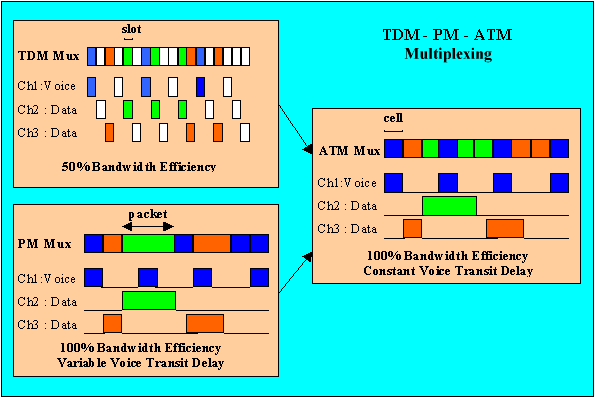
Figure 1: TDM - PM - ATM multiplexing
|
|
ATM FUNCTIONAL REFERENCE MODEL
To describe an ATM network and the various network components (ATM mux, ATM cross connect, ATM switch, ATM Access Devices, ATM Network Termination Unit), we will refer to the ATM functional reference model shown below.
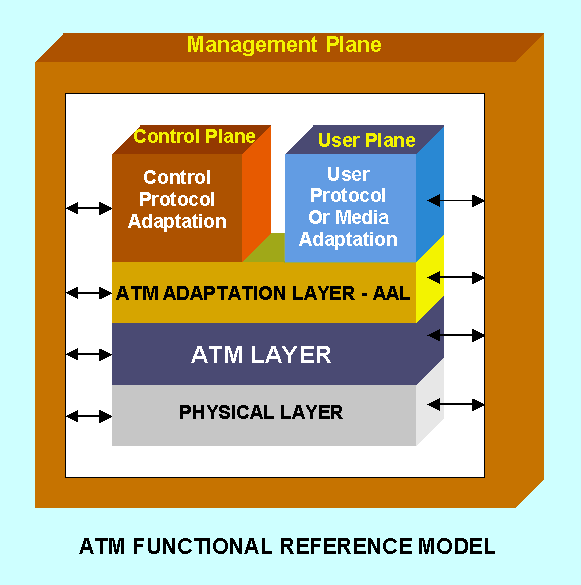
There are three main functional blocks:Figure 2: ATM reference model
The ATM layer provides the following services:
ATM CELL STRUCTUREThe ATM cell structure is represented in the next table with its two variants "UNI "and "NNI".
"UNI cells "are used at the User to Network Interface (UNI), "NNI cells" at the Network to Network Interface (NNI) connecting two ATM networks.Review of the different cell header fields:
Type ATM CELL Overhead HEADER PAYLOAD 5 Bytes 11 % UNI GFC VPI VCI PT CLP HEC NNI VPI 4 bit 8 bit 16 bit 3 bit 1 bit 8 bit 48 bytes
|
|
|
|
|
|
User data cell - EFCI=0 - AAL5_EOF=0 | EFCI=0: no congestion |
|
|
User data cell - EFCI=0 - AAL5_EOF=1 | AAL5_EOF=1 : end of AAL5 framing |
|
|
User data cell - EFCI=1 - AAL5_EOF=0 | |
|
|
User data cell - EFCI=1 - AAL5_EOF=1 | |
|
|
OAM F5 segment associated cell | OAM F5 is a maintenance flow (see Management plane § ) |
|
|
OAM F5 end-to-end associated cell | |
|
|
Resource Management Cell | Resource management cell: used for ABR flow control (see traffic management § ) |
|
|
For future use |
|
|
VCI | PT | CLP | USAGE |
|
|
|
|
|
|
Idle cell identification | Recommended by ITU |
|
|
|
|
|
Unassigned cell | Recommended by ATM Forum |
|
|
|
|
|
OAM F3 - physical layer | See "Management plane" § |
|
|
|
|
|
Segment OAM F4 - Virtual Path | |
|
|
|
|
|
End-to-end OAM F4 - Virtual Path | |
|
|
|
|
|
Segment OAM F5 - Virtual Channel | |
|
|
|
|
|
End-to-end OAM F5 - Virtual Channel | |
|
|
|
|
|
Point to Point Signaling channel | Dedicated
signaling channels.
VPI=0 commonly used between user and local exchange |
|
|
|
|
|
Broadcast Signaling channel | |
|
|
|
|
|
Meta-signaling channel | |
|
|
|
|
|
Resource management cell for VP | See "traffic management" § |
|
|
|
|
|
Resource management cell for VC | |
|
|
|
|
|
ILMI : Interim Local Management Interface | Management between user and network |
|
|
|
|
|
PNNI: Private Network-Network Interface | Dynamic routing protocol |
The Virtual Paths and Channels are innovative concepts that position ATM as the ideal technology to build Virtual Networks (VN) as Virtual LAN (VLAN), Virtual Enterprise Network (VEN) or Virtual Private Network (VPN) capable of supporting multiple services & media.
A VC or VP connection is made of VC or VP Links interconnected via multiplexers, crossconnects or switches.
- ATM VIRTUAL PATH & CHANNEL
- With ATM several types of connections are possible :Virtual Paths equivalent to flexible "digital lines", Virtual Channels that will carry the end-users communication applications. A connection is not only characterized by its end-points : source and destination but also by traffic service quality parameters (peak & average throughput, cell loss, transit delay).
The VCs are transported on VPs, themselves on Transmission Paths (TP) or Physical Links.
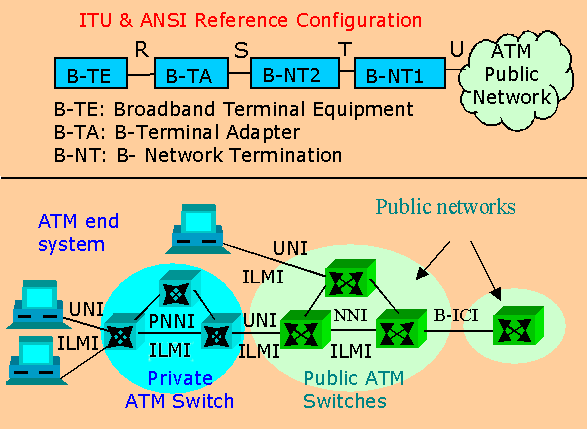
For details on VP, VC, QOS & traffic management, click on: ATM VIRTUAL SERVICE CONNECTION You will then return here To assure ubiquitous broadband ATM communications, standards for interoperability of ATM products and ATM networks are defined (still an ongoing work) by the ITU for the ATM public services and by the ATM forum for private ATM network. The ITU reference connection model (identical to narrowband ISDN) is shown on the next figure as well as the ATM network interfaces.
The different functions of this layer are split into two sublayers as presented in the next table.
|
|
|
|
|
HEC generation and verification
Cell scrambling and descrambling Cell delineation |
| Path signal indication | |
| Time phasing-pointer processing
Multiplexing Scrambling/descrambling Transmission frame generation/recovery |
|
|
|
Bit timing, line coding
Physical medium |
|
|
Bit rate (Mbps) |
|
|
|
|
| SDH-STM4 | 622 | SM-1300um fiber | NRZ | unlimited* | WAN |
| SDH-STM4 | 622 | MM-1300um fiber | NRZ | 300 m | LAN |
| SDH-STM1 | 155 | SM-1300um fiber | NRZ | unlimited | WAN |
| SDH-STM1 | 155 | MM-1300um fiber | NRZ | 2 km | LAN |
| SDH-STM1 | 155 | UTP5/UTP3 | NRZ/64CAP | 100 m | LAN |
| SDH-STM1 | 155 | Plastic-1300um fiber | NRZ | 50 m | LAN |
| TAXI (FDDI) | 100 | MM-1300um | NRZ-4B5B | 2 km | LAN |
| PDH-E3/DS3 | 45/34 | Coax-75ohms | HDB3/B3ZS | unlimited | WAN |
| ATM25 | 25.6 | UTP3 | NRZI | 100 m | LAN |
| PDH-E1/DS1 | 2.048 | TP/Coax-75ohms | HDB3 | unlimited | WAN |
| DH- DS1 | 1.544 | TP | AMI/B8ZS | unlimited | WAN |
| AIMUX | N*
E1/DS1 |
Same as PDH E1/DS1 | idem | idem | WAN |
| * : "unlimited" distance
because of the PDH & SDH WAN carrier networks
Acronyms: SM: Single Mode (fiber) - MM: Multimode - UTP: Universal Twisted Pair AIMUX: ATM Inverse Multiplexer |
|||||
| Bytes |
|
Path
OH |
|
||||||||||
|
|
A1 | A1 | A1 | A2 | A2 | A2 | C1 | C1 | C1 | J1 | |||
|
|
B1 | B1 | B1 | B3 | |||||||||
|
|
C2 | ATM | ATM | ATM | |||||||||
|
|
H1 | H1* | H1* | H2 | H2* | H2* | H3 | H3 | H3 | G1 | ATM | ATM | ATM |
|
|
B2 | B2 | B2 | K2 | -- | ATM | ATM | ATM | |||||
|
|
H4 | ATM | ATM | ATM | |||||||||
|
|
-- | ATM | ATM | ATM | |||||||||
|
|
-- | ATM | ATM | ATM | |||||||||
|
|
Z2 | Z2 | Z2 | -- | ATM | ||||||||
| **: fore more
details, refer to the SONET/SDH tutorial
A1,A2,B1,C1: Section management Channels - B2: Line error check H1,H2,H3: pointer to the STM-1 payload start J1,B3,C2,G1: Path management channels - H4: pointer to the ATM sequence start |
|||||||||||||
The ATM Adaptation Layer (AAL) is responsible for the conversion between user's data and ATM cells. The AAL layer is divided into separate functional sublayers as shown on the next figure.
|
|
|
|
|
|
Service Specific
Convergence Sublayer |
Protocol mapping and encapsulation |
|
|
Common Part
Convergence Sublayer |
Timing recovery for CBR & rt-VBR
Frame and channel delineation, Frame error checking |
|
|
Segmentation
And Reassembly |
Cell Segmentation & Reassembly, error detection & correction, Multiplexing |
|
|
|
|
|
|
|
|
Constant Bit rate
Timing synchronization Connection oriented |
E1,DS1
N*64 Kbps |
|
|
|
Variable Bit rate
Timing synchronization Connection oriented |
Packetized Video, Audio |
|
|
|
Variable Bit rate
Connection Oriented or Connectionless |
SMDS |
|
|
|
Variable Bit rate
Connection Oriented or Connectionless |
Data and protocols (Frame Relay, IP, X25), ATM signaling |
For details on AALs, click on: AALs BOLTS & NUTS You will then return here
The user plane connections are setup and released by the control plane, by a signaling exchange between the ATM end systems and the ATM intermediate systems (switches). ATM is a Connection Oriented protocol. The transmission characteristics (QOS, throughput, latency) are fixed during all the time the connection is active. Moreover, the signaling information and the user data do not share the same channel path; ATM uses an outband signaling scheme.
To identify the ATM network subscribers, there are two different standardized addressing schemes : E164 specified by the ITU for public networks and already used in ISDN and NSAP defined by the ATM Forum for private Networks. Multicast and anycasting (group addressing) is supported in addition to single addressing.
ATM supports permanent and switched connections of various types:
|
|
|
| . Point-to-Point connection set
up &release
. VPI/VCI selection & assignment . Quality Of Service class request . Traffic parameters request . Subaddress support . Identification of calling party . Transit Network Selection . Basic error handling . User-to-user signaling |
. Point-to-Multipoint
. Symmetric operation . Multipoint-to-Point or Multipoint . Multiple connections setup . Call Transfer . Call Forwarding . Call Offer . Call "Do not Disturb" . Multiple Subscriber Number Etc. |
To setup a route between the end users, when a setup message is received, the switches will strive for finding the best route to reach the destination but also to fulfill the traffic contract (service class, traffic parameters, QOS) requested by the user. For that purpose the ATM Forum has defined for private ATM networks:
|
|
ATM MANAGEMENT PLANE
Within the ATM functional reference model (see fig 2), the management plane is in charge of managing the different ATM layers of both the user and control planes. It must also undertake management coordination across the layers and the different planes, all this in order to ensure that everything works properly. It manages faults, performances, configuration, accounting and security within the ATM network.
To accomplish those different tasks, a management model has been defined
by the ATM Forum on the basis of the TMN (Telecommunication
Management Network) used in public networks and standardized
by the ITU.
The management services are structured in different layers: the Network
Elements (NE) management, the network management itself, the service management.
Basic Management entities (agents, managers) are accordingly defined with
the interfaces interconnecting them.
For each interface, a management protocol is defined: SNMP
for private networks, CMIP for public
networks), as well as the management information (MIB)
processed in those entities and related to the ATM network and services.
To simplify the configuration of ATM network devices, a special protocol,
the ILMI has also been defined by the
ATM Forum, with its associated MIB.
To monitor in real time operational status and performance of the ATM connections (VC, VP, Transmission Path), special maintenance flows (OAM flows) are specified. They are also used to verify proper operation of the VCs and VPs through activation of loopbacks.
|
|