 "
The Wise Way to The World of Communications"
"
The Wise Way to The World of Communications"
ATM MANAGEMENT PLANE
|
|
|
|
|
As shown on the ATM functional reference model, the management plane covers the management of the different ATM layers of both user and control planes as well as the management and coordination across layers and across the different planes to ensure that everything works properly. It manages faults, performances, configuration, accounting and security within the ATM network.
NETWORK MANAGEMENT FRAMEWORK
The different standardized management interfaces are shown below
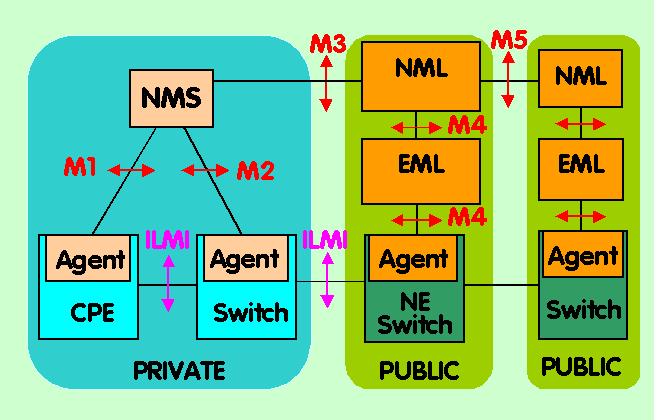
| NMS: Network Management System- CPE: Customer Premises Equipment - NE: Network Element - EML: Element Management Layer - NML: Network Management Layer |
MANAGEMENT INTERFACES
They have been defined between the different entities of the management model
|
|
|
|
|
|
|
|
CPE / NMS | Management of user terminal equipment | SNMP | |
|
|
P-Switch / NMS | Management of the ATM private network | Similar to M4 | SNMP |
|
|
NMS / NML | Management interaction between private and public domains | . Public network configuration and
status gathering
. Add & deletion of pre-authorized VCs . new connection request |
SNMP |
|
|
NML / EML or
EML / NE |
Management of NE's and EMLs | . Fault and performance management
. Configuration and circuit provisioning . accounting |
CMIP
(Q3) or SNMP |
|
|
NML / NML | Management interaction between different owned public domains | Cross public network management | No standard yet |
|
|
Private/public | Service control | Service activation, service assurance (maintenance), usage metering (performance, billing) | ILMI - SNMP |
ATM MIBS
They define (or will define) the information exchanged at the M1 to M5 interfaces. They are related to the various ATM Management Elements (AME) or ATM managed objects (physical ATM devices, links, connections, services, etc). A summary of the currently standardized MIBs is presented in the next table.
|
|
|
|
|
|
Configuration across ATM devices | ATM Forum UNI 3.x & 4.0 |
|
|
AME for SONET/SDH or other Physical Media | ITU G704,G774
IETF RFCs 1595,1407,1406 |
|
|
Inverse Mux on N*E1/T1 | ATM Forum [M2,M4] |
|
|
Router-DSU interface | ATM Forum [M1] |
|
|
AME for private networks & devices | IETF RFC 1695
ATM Forum [M1,M2] |
|
|
AME for circuit emulation | ATM Forum [M2,M4] |
|
|
AME for LAN emulation | ATM Forum [M1,M2] |
|
|
AME for customer's portion of public network | ATM Forum [M3] |
|
|
AME for carrier network elements | ATM Forum [M4 NE] |
|
|
AME for carrier network | ATM Forum [M4] |
|
|
AME for carrier network | ITU-G.ATM (M3100) |
|
|
AME for carrier networks interconnection | ATM Forum [M5] |
An important management interface is the ILMI because it does contribute to ease configuration with a "plug & play" approach.
ILMI
ILMI is a peer-to-peer protocol that facilitates automatic configuration of ATM equipments. It uses the SNMP syntax, has its own service MIB and allows management requests from both the ATM end system and the ATM switch. It has a dedicated ATM channel (VPI=0/VCI=16). The management features of this interface and its evolution with the successive UNI releases are presented in the following table.
|
|
| . Interface configuration, maximum number of
connections, speed, media type, private or public interface, operational
status and QOS for each connection (VPC & VCC)
. Automatic learning of NSAP network prefix address, address registration auto-discovery of network topology Multiple links management |
The management of the physical and ATM layers is also performed via the Operation, Administration and Maintenance (OAM) flows
OAM FLOWS
As previously mentioned in the "ATM Layer" section of this tutorial, the different levels of transmission channels (transmission path and section, the end-to-end and segment VP, the end-to-end and segment VC) are supervised via the F3 to F5 flows. They provide real time monitoring and troubleshooting which SNMP is incapable of.

More precisely they perform the following functions: performance monitoring (error rates), defect and failure detection, system protection (in case of link failure), forwarding of failure and performance information and fault localization.
| FLOW | Supervised object | OAM cells | OAM channel identification |
| F1 | SDH - Regeneration section | N/A | N/A |
| F2 | SDH - Digital section | N/A | N/A |
| F3 | Transmission Path | LOC, failure in idle cells processing | VPI=0, VCI=0, PTI=100 |
| F4 segment | VP Link | AIS, FERF, LOOP | VCI=3 |
| End-to-end F4 | VP connection | VCI=4 | |
| F5 segment | VC Link | PTI=100 | |
| End-to-end F5 | VC connection | PTI=101 | |
| N/A: Non Applicable
(internal to SDH/SONET networks)
AIS: Alarm Indication Signal (sent downstream to notify upstream failure) - RDI: Remote Defect Indication (to notify in the reverse direction the faulty condition) - FERF: Far End Reporting Failure - LOC: Loss of Cell Delineation LOOP: controls loopbacks to verify part or the end-to-end connection |
|||
|
|
|
|
|
