
|
|
|
|
|
 "
The Wise Way to The World of Communications"
"
The Wise Way to The World of Communications"
ATM CONTROL PLANE
BACK TO ATM TABLE OF CONTENTS CONTROL PLANE
The Control Plane is responsible, on user's behalf, for the control of:
To support multimedia concurrent applications, an ATM call can control several simultaneous connections with their own QOS; they can be routed through the same physical path, with the Common Routing Group facility.
The architecture of the control plane is described below.
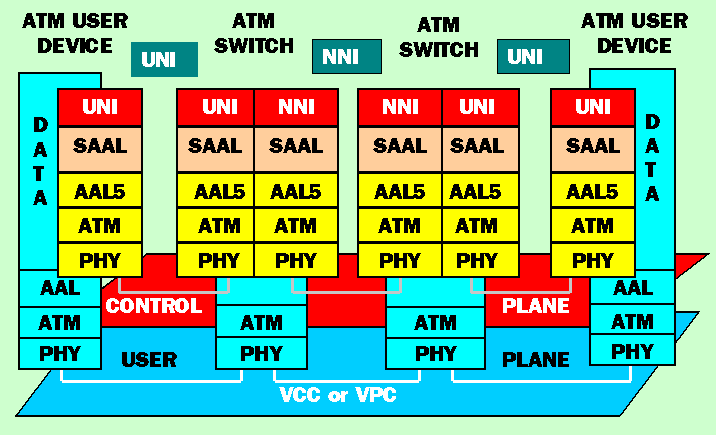
SAAL: Signaling AAL
The user plane connections are setup and released by the control plane, by a signaling exchange between the ATM end systems and the ATM intermediate systems (switches). ATM is a Connection Oriented protocol, whereby user data can be exchanged only after a connection has been established. The transmission characteristics (QOS, throughput, latency) are fixed during the whole connection. To change them, the connection needs to be released and reestablished. Moreover, the signaling information and the user data do not share the same channel path; ATM uses an outband signaling scheme.
Connection control requires that each network entity (including the user terminal) be identified by a unique address.
ATM ADDRESSING
There are two standardized addressing schemes:
| E164 | U/M | Country
Code |
Area | City | Exchange
(switch) |
End System |
| 4 bit | 12 bit | 6 Bytes | ||||
| 1 D | 3 D | 12 D | ||||
| U: Unicast - M: Multicast | ||||||
NSAP is more complicated to take into account different numbering schemes in use by private organizations.
| NSAP |
|
|
|||||||
|
|
|
|
|
|
|||||
|
|
|
|
|
|
|
|
|||
|
|
|
|
|
|
|
|
|||
|
|
|
|
|
|
|
|
|||
|
|
|
|
|
|
|
||||
|
|
|
|
|
||||||
| IDP: Initial Domain Part - DSP: Domain Specific Part - AFI: Address Format Identifier - IDI: Initial Domain Identifier - HO: High Order - ESI: End System Identifier - SEL: Selector - DCC: Data Country Code - DFI: Domain Format Identifier - AA: Address Authority - ICD: International Code Designator - RD: Routing Domain | |||||||||
In ATM it is also possible to identify not only single users but also groups of users. ATM signaling does support multicasting and anycasting.
ATM SIGNALING & ROUTING
As said before, connections between end users are set up and released by the signaling linking the user to the network and, within the network, the different switches. In fact rather sophisticated connection services can be provided as underlined hereafter.
|
|
|
| . Point-to-Point connection set
up &release
. VPI/VCI selection & assignment . Quality Of Service class request . Traffic parameters request . Subaddress support . Identification of calling party . Transit Network Selection . Basic error handling . User-to-user signaling |
. Point-to-Multipoint
. Symmetric operation . Multipoint-to-Point or Multipoint . Multiple connections setup . Call Transfer . Call Forwarding . Call Offer . Call "Do not Disturb" . Multiple Subscriber Number Etc. |
To provide those connection services, the ATM end system and network nodes use a signaling protocol, specified by the ITU for the public ATM networks and the ATM Forum for private ones. There are two different versions: UNI (User-to-Network) and NNI (Network-to-Network)
SIGNALING PROTOCOL
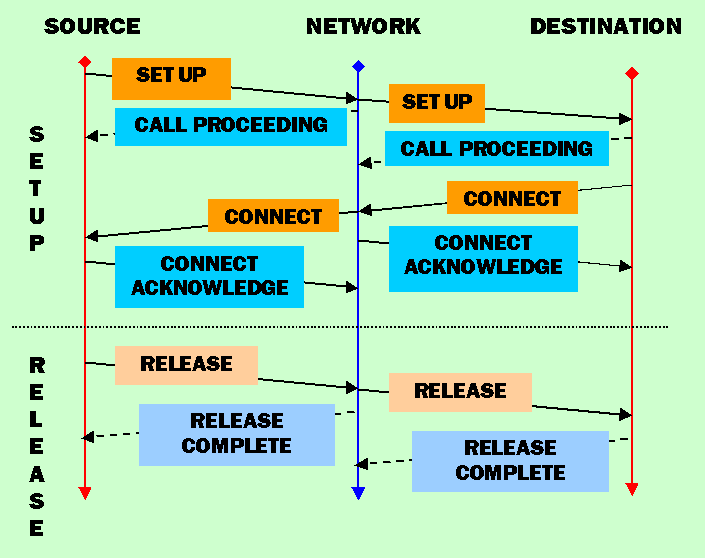
ROUTING
The purpose of routing is to find a "route" between the calling and the called parties that fulfills the user requested connection traffic contract. A route is a succession of VC/VP links (identified by the VPI/VCI cell header field) making up the VCC/VPC connection. Each switch holds a routing table defining for each connection the relationship between the input VCI/VPI link and the VCI/VPI output link
Different routing algorithms can be used, either static or dynamic.
- With static routing, the switches are interconnected through fixed internal routes (fixed routing table). Thus, in reference to the next figure, to go from User U1 to User U2, the connection will be established via Switches A and B. If unfortunately the A-B link breaks, U1 cannot communicate with U2 although there is an alternate path A-C-B.
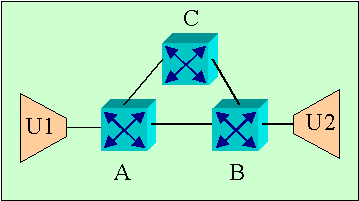
A refinement to static routing is alternate routing where an alternate route backs up the fixed route. In our example, Switch A will have two possible routes to reach B either directly (via A-B) or via Switch C. When Switch A will receive a call set up message (U1to U2), it will check if the A-B link is operational. If yes, it will forward the Setup Message to Switch B and establish a VC link with B. If no, the A-C link will be used and a VC link established with Switch C. C will further process the Setup Message and establish a VC link to Switch B.
The ATM Forum has standardized a dynamic routing protocol, the PNNI (Private Network-to-Network Interface) to be used in ATM end systems and ATM switches. It does carry not only reachability information but also trunk and switches traffic capabilities to ensure "QOS & traffic descriptor" specified connections. It is based on an hierarchical network structuring, whereby the network is divided into domains, themselves into "peer groups". Each switch in a group has detailed information on his peers but not on the outside except one of them so called the Peer Group Leader that represents (with summarized reachability and traffic load information) the group in a higher order peer group (its parent). It forwards to his peers the summarized information he gets from is parent group.
- With dynamic routing, for each user requested connection, the best route fitting the requested traffic contract will be found out. In our previous example, Switch A will select the A-B path or the "A-C & C-B" path on the basis of the traffic loads on those paths. Therefore U1 could communicate with U2 via A-B at a given time and later, at the next connection, via A-C-B depending on the network load.
To achieve it, the switches A, B and C shall exchange topology and network load information. Switch A learns that, to reach U2, two paths are possible (A-B and A-C-B) and knows at each instant the traffic conditions of these two paths. It will then select the proper one when U1 wants to communicate with U2.
This structuring is comparable to the that of the telephone network with different switches hierarchies: local switch, area switch, transit switch (national and international). It relieves any individual network switch to store and process all the reachability and traffic conditions of the whole network, which would be an enormous amount if the network would consist of several hundreds of switches.
After network routing information collected, a given switch must, at the reception of a setup message, decides which route to use. This is done by the so-called Connection (or Call) Admission Control (CAC) algorithm. PNNI standard has replaced it by the Generic CAC
|
|
|
|
|