" The Wise Way to The World
of Communications"

" The Wise Way to The World
of Communications"
NETWORKING UNDERLYING
CONCEPTS
|
Table of Contents
|
In this WWWnet section, we will address the networking 4*W questions:
The What: Information contents and users of networks
- The When: "Time" dimension of networks
- The Where and Who: "Space" and "User" dimensions
- The hoW : Network architectures and protocols
NETWORK: UBIQUITOUS COMMUNICATION TOOL
We spend most of our time to communicating at home with our family
and our friends, with our society, at work with our colleagues, our
managers, our employees.
We also communicate with non-human beings: answering machines, mail
and voice boxes, computers, information servers (data, audio, video),
interactive games, and so on. It is just incredible how many
communication tools we are using (with quite often awkward user
interfaces). Indeed we can't stay passive with information. We need
to interact with it and exercise our own control. We need also to
communicate it.
The network drivers are:
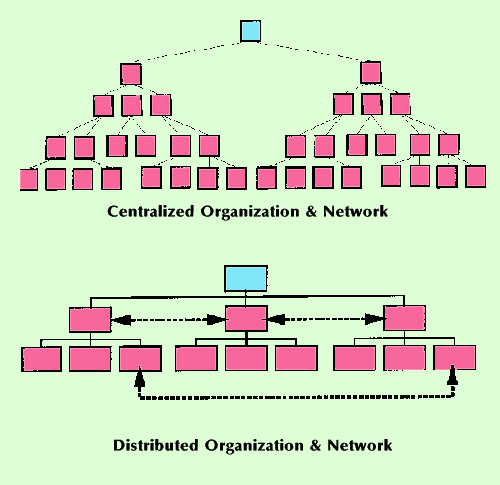
This trend is reflected in network architectures evolving from
centralised (around the host computer) to partially distributed
"client/server" and eventually to fully distributed
("peer to peer").
Also increasingly networks are tuned to work-groups with the group
members being interconnected locally or remotely through their
network which becomes then a vital group resource.
|
Telephony |
Distributed data access |
Public services |
|
Facsimile |
Remote data base access |
Home shopping |
|
|
Remote computing |
Entertainment imaging |
|
Voice mail |
Collaborative computing |
Video on Demand |
|
Distance learning |
Telecommuting |
Audio CD on Demand |
|
Audioconferencing |
Industrial Engineering |
Interactive games |
|
Videoconferencing |
Distance customer training |
Virtual reality |
|
Medical Imaging |
Electronic Fund Transfer |
Education |
|
Electronic publishing |
Electronic commerce |
Home study |
|
Desktop publishing |
Financial data and trading |
Communication Applications
Each media (voice, data, video) has had and still has its own dedicated network. Multimedia and integrated multiservice networks tend to appear with the Internet (Voice over Internet is not yet practical for everyone but it will come) and the future Broadband ISDN. This issue will be addressed at length later in the document.
Communication quality and efficiency relies upon latency, that is the time to transmit information end to end, and on transmission bandwidth or Transfer rate.
Don't confuse latency and bandwidth. High bandwidth
doesn't imply necessarily low latency, especially when you share
bandwidth with other users. Currently high speed packet switching
networks (IP or X25) cannot carry properly voice traffic. They have
no control of the transmission delay.
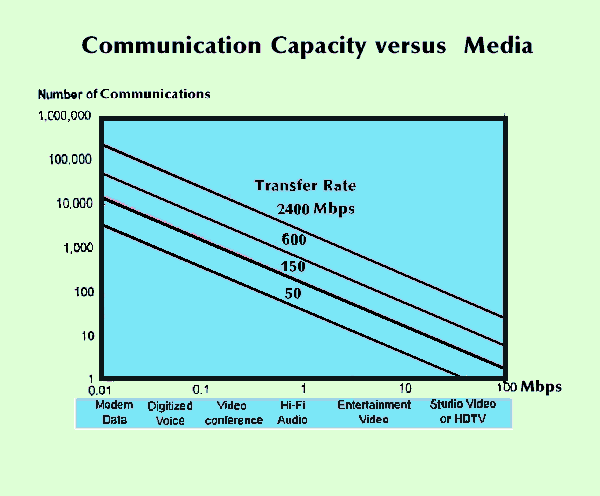
But audio, pictural or video communication requires much more
bandwidth than text as underlined in the following figure showing,
for a given communication media the number, of simultaneous
communications carried by transmission channels of different transfer rates.
With a 2.4 Gbit/s channel no more than 40 HDTV communications can
take place concurrently.
Media compression reduces network load. Typical compression factors
range from 10 to 100 but at the expense of less quality and less
content transparency.
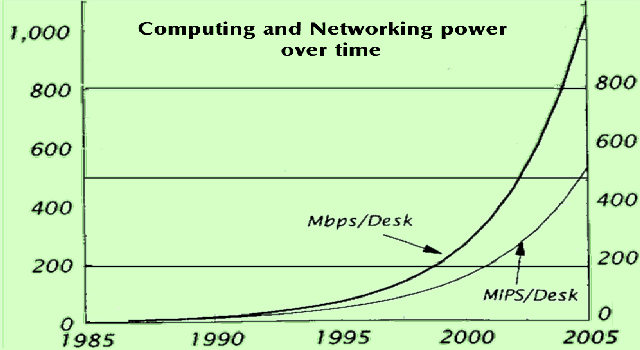
So there is an exponential growing need of network bandwidth, with a
rapid change from Low/Medium speed networks to High/Very High speed
ones. The Time (throughput and
latency) is indeed a shaping dimension of networks
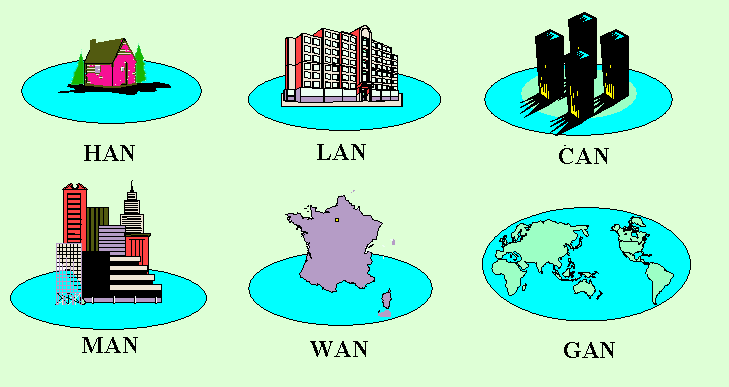
Space Dimension : Communication takes place in a space where the communication actors (human beings, machines) are present. There are varieties of networks with different technologies that fit to different communication spaces (see the table below).
|
NETWORK TYPE |
DEFINITION |
DISTANCE RANGE* |
COMMUNICATION SPACE |
|
HAN |
Home Area Network |
0.1 km |
home |
|
LAN |
Local Area Network |
0.1 to 1 km |
building, floor, room |
|
CAN |
Campus Area Network |
1 to 10 km |
campus, company site |
|
MAN |
Metropolitan Area Network |
10 to 100 km |
city |
|
WAN |
Wide Area Network |
100 to 10000 km |
region, nation |
|
GAN |
Global Area Network |
around the earth |
multinational zones, world |
|
|
|||
Moreover networks are dependent on the user community (Research, University, Enterprise, on their activity and the computing means they use (IBM, DEC, Microsoft, Novell,...) .
The user and space dimensions are indeed closely related: the LAN
network connects the people in the same company building, the MAN in
the same city.
But with telecommuters or home workers, the relationship between
space and user community (Engineering or Sales in a company) is broken.
A LAN work-group network should also link remote group members. A new
type of network addresses this need: the VIRTUAL
LAN, more generally VIRTUAL network
which is space independent but user dependent.
They reflect the Time, Space, User dimensions.
In the Data communication field, usually the Enterprise networks are divided into:
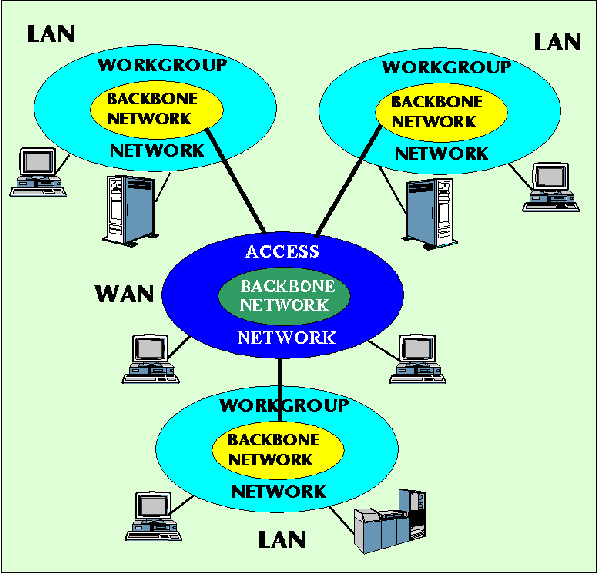
The users are connected to the LAN work-group sub-networks,
themselves to the LAN backbone network.
LAN networks are interconnected through the WAN via the WAN access
and backbone networks. Isolated users, such as home workers, are
connected directly to the WAN to access the Enterprise network.
Companies with many dispersed agencies, close to the customers, (as banks, insurance companies, post offices,..), have a lot of WAN connections hierarchically organised in a "three tier" configuration with "Branch Offices", "Regional Offices "Headquarters".
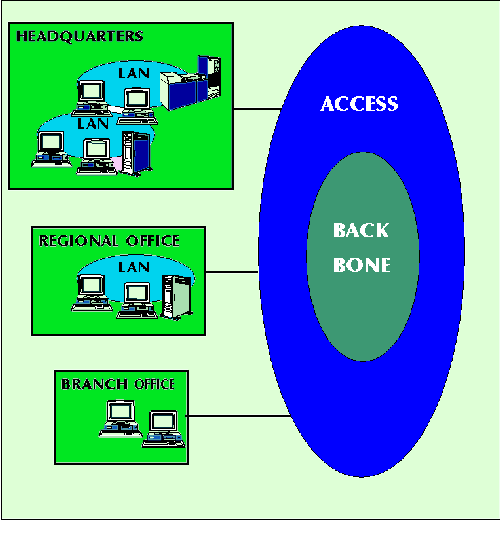
The traffic flows increase from the branch offices to the
headquarters by roughly a factor of 10 at each level.
With this tendency to more geographical dispersion and with the : "small
offices" with a very few employees and "home
offices".
voice, sound and video : real time continuous transmission is a must . They can't suffer too much delay because of echo phenomenon that degrades sound quality. The transmission delay has to be fixed or with very small variations. The traffic is usually continuous and constant overtime, except for compressed video with a variable coding bit rate.
data : error free transmission is usually a request. Variable delays are well tolerated because of their "message" format. Large delays can be also annoying in interactive data applications. Data has a bursty traffic characteristics with long idle times.
Due to those differences, currently different networks are used:
Data networks : structured around LAN and WAN data networks. Although the voice network is used to carry data signals, there are also more efficient dedicated PTT data networks: PSDN (Packet Switched Data Network), CSDN (Circuit Switched Data Network). INTERNET is in that category of dedicated data networks.
Video networks: They are broadcast networks with little inter-activity and use satellites and cables.
Multimedia networks : The current
network infrastructures do not address the multimedia and
multiservice communications where voice, data, fax, video signals are
simultaneously transmitted. An attempt has been made with ISDN that
can transport voice, fax and data but not video which will be taken
into account by the future Broadband ISDN.
To day considerable efforts are devoted to set up experimental new
multimedia networks, so called information highways. INTERNET is a
good candidate but the embedded protocols need to evolve to carry
real time signals as voice and video.
Communications involve terminals, communication applications and the
linking network. They all interact to assure proper transportation
(Link set up, transfer, Link release) and optimal use of the network
transport services.
In order for this interaction to take place, a communication protocol
is necessary between the end user and the network but also within the
network, between the different network nodes. It will be in charge of
establishing end to end routes according to the user's request, of
transferring information reliably and safely, monitoring and
controlling the network.
To structure these communication interactions and implied services, a reference model has been defined: the Open Systems Interconnect Reference Model (OSIRM).
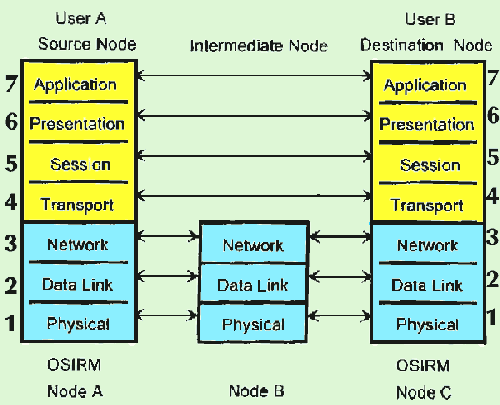
The seven layers OSI model
Other models exist such as the IBM, DEC, Novell and Microsoft ones to
structure communication exchanges. They are quite similar and tend to
converge to the OSI model at the network level with IP being the
ubiquitous data gram protocol
|
LAYER |
SERVICE |
NETWORKS |
|
Physical |
Transparent bit stream transmission |
Analog: Leased Lines & PSTN - Digital: DLL, SONET/SDH, ISDN - LAN: ETH, TR, FDDI |
|
Data Link |
Error detection/correction- Multiplexing-Traffic management-Media access (MAC) |
LAN, FR, ATM, SNA |
|
Network |
End to end addressing-Routing-Switching -Multiplexing-In sequence delivery-Flow control-Traffic management |
X25, IP, SMDS, SNA Switched FR, ATM, ISDN, PSTN |
|
Transport |
segmentation,reassembly-multiplexing-Flow control-Error correction |
Terminal , Computer Domain |
|
Session |
connection management-flow management-address translation |
|
|
Presentation |
user's data formatting |
|
|
Application |
Mail, Directory services, File transfer, Remote terminal, Audioconferencing,... |
|
|
NOTES: |
||
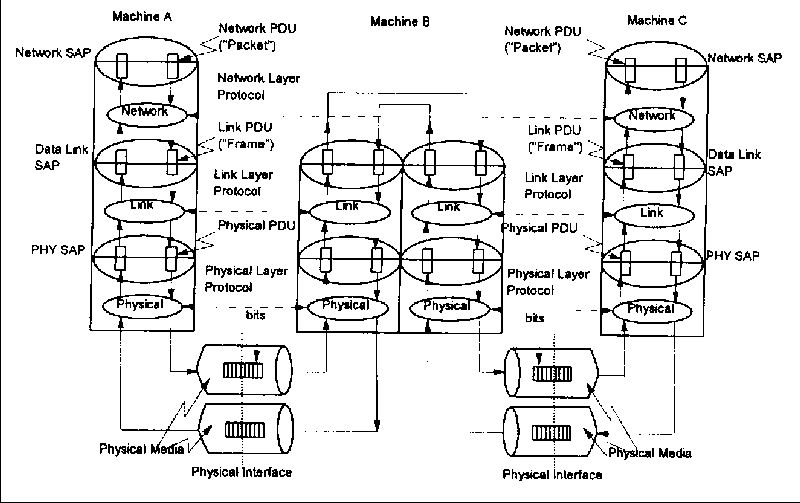
Network Communication protocols
After jumping through these seven layers, the initial user message
will have a lot of overhead added by the different layers it went through.
But the big advantages are their open
(making possible any to any communication) and perennial
attributes, thanks to the independent layer structuring, hiding
communication applications from the variety and constant changes of
the communication networks. Indeed the same computer application
(File transfer, for instance) can run on Ethernet, Token Ring, X25,
Frame Relay, ATM, ISDN networks.
So, networks are also structured by service layers with dedicated layer networks. It's a fifth dimension to the network structuring, in addition to time, space, user and media, although all of them are not independent, which makes networks complicated to understand.
After this long digression on the underlying concepts of networks, let make it straight and simple.
Two fundamental elements shape networks: their architecture and their embedded protocol.