" The Wise Way to The World
of Communications"

" The Wise
Way to The World
of Communications"

SDH TRANSMISSION BACKBONE
|
| ||||
|
|
The physical connections netting the telephone network are usually digital and organized into concentration stages agglomerating the traffic of suburbs, cities, regions, nations and between nations. It's done via TDM (Time Division Multiplexing) equipments spread all over the telephone network and CODECS that convert analog signals into digital and vice versa.
This digital infrastructure is used to carry the voice traffic but also is the carrier of digital data networks (digital leased lines and ISDN)
There are two TDM transmission systems with their hierarchy in
use: "plesiochronous (nearly synchronous) digital hierarchy (PDH)"
and "synchronous digital hierarchy (SDH)", the most recent one
providing higher speed channels.
This hierarchy was developed nearly 40 years ago to carry digital voice channels. It structures the transmission infrastructure into several layers. Different hierarchical levels are used in North America, in Europe and in Japan.
|
|
|
Channels |
| ||
|
|
|
| |||
|
|
|
|
|
|
|
|
|
|
|
|
|
|
|
|
|
|
|
|
|
|
|
|
|
|
|
|
|
|
|
|
|
|
|
|
|
|
|
|
|
|
|
|
|
|
|
|
|
|
|
|
|
|
|
|
|
|
|
|
|
|
|
|
|
|
|
|
|
|
|
|
|
|
|
|
|
|
|
|
|
|
|
|
|
|
|
|
|
|
|
|
|
|
|
|
|
|
|
PDH : Plesiochronous Digital Hierarchy DS : Digital Stream - T or E refers to transmission repeater systems | |||||
PDH is an asynchronous multiplexing scheme in the
sense that the different tributary channels don't have to be
clock synchronized between them and with the aggregate channel.
A centralized and very stable network clock is unnecessary
avoiding the problems of clock stability, recovery and
distribution.
But the consequence is the implementation complexity of cross
connecting the aggregated channels, with demultiplexing and
remultiplexing at each cross connect node.
There are two standards for the synchronous digital hierarchy: SONET (Synchronous Optical NETwork) for North America and SDH (Synchronous Digital Hierarchy): the ITU international standard.
The SONET or SDU transmission system is structured in
several levels, each of them characterized by a transport
channel called the Synchronous Transport Signal (STS) in SONET,
the Synchronous Transport Module (STM) in SDH.
This channel is transmitted over an Optical Carrier (OC).
The different possible SONET /SDH levels are presented in the following table:
|
level |
OC level |
Mbps |
(64 Kbps) |
(1.544 Mbps) |
(44.376 Mbps) |
|
|
|
|
|
|
|
|
|
|
|
|
|
|
|
|
|
|
|
|
|
|
|
|
|
|
|
|
|
|
|
|
|
|
|
|
|
|
|
|
|
|
|
|
|
|
|
|
|
|
|
|
|
|
|
|
|
|
|
|
|
|
|
|
|
|
|
|
|
|
|
|
|
|
|
|
|
The predominant used channels are the STM-1 (or STS-3) and the STM-4 (or STS-12).
It is a superhighway using fiber optics that rings most major cities and provides terabits worth of bandwidth. It is the basic foundation, the underlying transmission network of very high-speed networks such as ATM or SMDS, but also of terrestrial Video networks.
The STS or STM transport channel aggregates lower speed channels (e.g. 4 STM-1 into 1 STM 4) and also multiplexes T1 or E1, T3 or E3. The aggregated streams are called Virtual Tributaries (in SONET), Virtual Containers (in SDH).
There are also different levels of tributary channels as
listed in the next table.
|
|
|
|
|
|
|
|
|
|
|
|
|
|
|
|
|
|
|
|
|
|
|
|
|
|
|
|
|
|
|
|
|
|
|
|
|
|
|
|
|
|
|
NOTES: | |||
The multiplexing scheme is organized into functionally independent blocks with "header" and "payload" sections and built around (9 rows * 90 columns) frames.
|
OH 3 rows |
|
|
|
|
|
|
|
|
|
|
|
|
|
|
|
|
| |
|
|
|
|
|
|
|
|
| |
|
OH
|
|
|
|
|
|
|
|
|
|
|
|
|
|
|
|
|
| |
|
|
|
|
|
|
|
|
| |
|
|
|
|
|
|
|
|
| |
|
|
|
|
|
|
|
|
| |
|
|
|
|
|
|
|
|
|
|
|
|
|
|
NOTES: | ||
The total frame size is N*9*90 bytes = N* 6480 bit.
The frame rate is 8 Kbps.
The frame bit rate is N* 51.84 Mbps.
|
|
|
|
|
|
|
|
|
|
|
|
|
|
|
|
|
|
|
|
|
|
|
|
|
|
|
|
|
|
|
|
|
|
|
|
|
|
|
|
|
|
|
|
|
|
|
|
|
|
|
|
|
|
|
|
|
|
|
|
|
|
|
|
|
|
|
|
|
|
|
|
|
|
|
|
|
|
|
|
|
|
|
|
|
|
|
|
|
|
|
|
|
|
|
|
|
|
|
|
|
|
|
|
|
|
|
|
|
|
|
|
|
|
|
|
|
|
|
|
|
|
|
|
|
|
|
|
|
|
|
|
|
|
|
|
|
|
|
|
|
|
|
|
|
|
|
|
|
|
|
|
|
|
|
|
|
|
|
|
|
|
|
|
|
|
|
|
|
|
|
|
|
|
|
|
|
|
|
|
|
| ||||||||||||||||
The T1 n°1 has its 27 bytes of data located in the
9*rows-columns n°1, 30 and 59 of the 86*columns payload,
T28 in columns 28, 57, 86.
A given T1 has an allocated frame space of 27*8 =216 bit. The
first two bytes don' convey user 's data: the first is a VT
pointer to let the VT floating within its frame space, the
second one is a VT level path "housekeeping" Overhead. The byte
25 is used to carry the T1 framing bit. User's data is thus
made of 24 bytes=192 bit as expected.
The overall overhead of T1s transport over STS-1 is 17% (3*28+6*9=138 overhead bytes out of the 810 STS-1 frame bytes).
In fact those so-called overheads, in fact Operation-Administration and Maintenance Channels, create the flexibility, the transmission quality and the supervision of the STS-N carrier channels.
An STS-N channel object is characterized by three elements:
Each of those elements has its own data carried within the STS-N frame.
Payload pointers allow the payload to float anywhere within the STS-N frame. The payload will often overlap multiple frames. To cope with possible transmission jitter, network equipments will update the pointers.
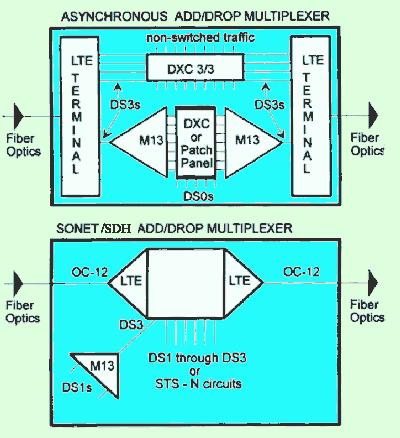
The pointers (within the Line OH and VT OH) allow to drop-insert and cross connect STS-N channels and their Virtual Tributaries, without any demultiplexing and remultiplexing
To provide the transmission, the multiplexing and cross connect services, the network uses the following network elements:
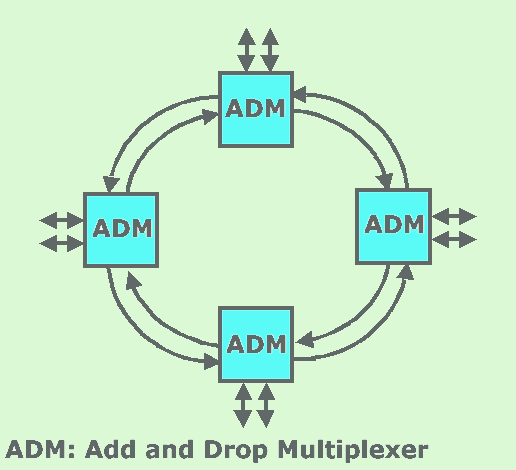
They provide T1/E1 and T3/E3 access to the SONET/SDH infrastructure. They are much more efficient in implementation than their PDH counterparts as underlined below.
The SONET-SDH transmission and multiplexing system enables nation-wide and worldwide (in a near future) broadband communications. It is also an integrated multimedia network conveying digital voice, data and video.
It provides a large variety of transport services with a large
range of transfer rates from 64 Kbps to 622 Mbps.
It is almost an error free transmission medium with built in
redundancy to protect against line outages. It is quite flexible
with on demand bandwidth capability and also on demand drop-insert
features.
All these reasons explain the success of SONET-SDH networks that are spreading in the public networks but also in Metropolitan networks (MAN) and even in Campus Networks (CAN). The new high speed ATM or SMDS services rely on this digital high-speed error free transmission infrastructure.
